En cualquier modelo de gestión de crisis, los planes de comunicación representan una parte esencial de la fase de respuesta. Más aún, cuando un destino como España tiene tanta dependencia del turismo internacional, cuidar la comunicación hacia el exterior es fundamental para transmitir la confianza que es necesaria para que gobiernos, operadores y turistas potenciales adopten sus decisiones a partir de una imagen positiva y veraz con relación al factor clave en el escenario marcado por la actual pandemia: la seguridad.
La seguridad tiene una doble dimensión: objetiva por un lado, que se puede plasmar en indicadores (absolutos y relativos) cuya medición responda a fuentes fiables y criterios científicos, y subjetiva por otro, que no siempre coinciden, ya que ésta depende de las percepciones de las personas. Precisamente, para tratar de minimizar esa brecha, las acciones de comunicación coordinadas y la colaboración con los medios de mayor cobertura e influencia a escala internacional, sobre todo en los principales mercados emisores, deben estar entre las prioridades de los gestores de los destinos.
Cierto es que al margen de esos esfuerzos por articular una comunicación clara y objetiva, existen otros intereses (por ejemplo políticos más allá de los estrictos criterios de salud pública) ajenos al control de dichos gestores que hacen que el resultado de esas acciones no dependa sólo de cómo las mismas fueron concebidas y ejecutadas, acrecentando la complejidad del problema. Por ello, cuando hablamos de la escena internacional, el despliegue diplomático es otra de las bazas a jugar.
Sea como fuere, observar cómo nos ven desde fuera resulta un ejercicio muy instructivo que ayuda a entender porqué estamos como estamos. A tal fin, el "Coronavirus News Monitor" es una herramienta muy interesante que rastrea la información más reciente acerca del nuevo coronavirus y, sobre los temas que transmiten los medios de comunicación social, calcula una serie de índices. Ha sido desarrollada por la empresa de análisis de datos RavenPack, con sedes en Nueva York y Marbella. Actualiza continuamente sus datos, que pueden consultarse en:
https://coronavirus.ravenpack.com/
En las imágenes siguientes se muestran los datos correspondientes a España a día de hoy.
El primer indicador es el Coronavirys Panic Index, que mide el nivel de noticias que hace referencia al pánico o la histeria y el coronavirus. Los valores oscilan entre 0 y 100, donde un valor de X indica que el X por ciento de todas las noticias a nivel mundial habla de pánico y la COVID-19. Cuanto mayor sea el valor del índice, más referencias al pánico se encuentran en los medios. Como puede observarse, la tendencia a la baja se ha invertido en las últimas semanas. A la vez, llama la atención que los datos de España han estado siempre nítidamente por encima del índice de pánico mundial. La situación de España ha despertado (y sigue haciéndolo) más pánico en los medios, lo cual no ayuda a la recuperación de la confianza que necesita el sector turístico.

El segundo indicador es el Coronavirus Media Hype Index, que mide el porcentaje de noticias que hablan sobre el nuevo coronavirus. Como en el índice anterior, los valores oscilan entre 0 y 100, donde un valor de X indica que el X por ciento de todas las noticias a nivel mundial están hablando de la COVID-19 (y España, en nuestro análisis). Como puede observarse en la imagen que sigue, la exposición mediática que ha tenido España en esta crisis ha sido muy alta, superior, por poner un ejemplo, a la de Estados Unidos. Con relación a España la pandemia se ha convertido en prácticamente el monotema, lo cual nos parece congruente con esos niveles de pánico indeseables referidos más arriba.

El tercero es el Coronavirus Fake News Index. Mide el nivel de conversación en los medios sobre informaciones erróneas o noticias falsas relativas a la COVID-19. Funciona de la misma manera que los anteriores, es decir, un valor de X indica que el X por ciento de todas las noticias a nivel mundial (relacionadas con España) está hablando de noticias falsas sobre la COVID-19; por tanto, cuanto mayor sea el valor del índice, más referencias a noticias falsas se encuentran en los medios. Comparando los valores del índice a escala nacional y a escala global, España está muy por encima, siendo éste otro factor que contribuye a crear escepticismo, más que confianza en la información.

En cuatro lugar, nos encontramos con el Coronavirus Sentiment Index, que mide el nivel de sentimiento en todas las entidades mencionadas en las noticias sobre el coronavirus. El índice oscila entre -100 y 100, donde un valor de 100 es el sentimiento más positivo, -100 es el más negativo y 0 es neutral. Aunque, como tendencia, ese sentimiento ha ido mejorando, incluso en Italia (un país que parece adecuado para una comparación de este tipo), el sentimiento expresado ha sido, en general, menos negativo que en España, salvo en los momentos iniciales. Esta mayor negatividad tampoco contribuye a construir una respuesta que favorezca la imagen del destino.

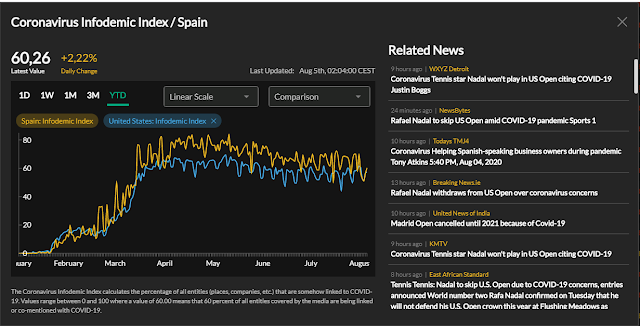
En penúltimo lugar tenemos el Coronavirus Infodemic Index, que calcula el porcentaje de todas las entidades (lugares, empresas, etc.) que de alguna manera están vinculadas a la COVID-19. Los valores oscilan entre 0 y 100, donde un valor de X significa que el X por ciento de todas las entidades cubiertas por los medios están vinculadas a, o co-mencionadas con, la COVID-19. La gráfica que sigue muestra la comparación con Estados Unidos, donde tanta importancia tienen los medios de comunicación y en el que, a pesar de ello, los porcentajes de este indicador han estado por debajo. La asociación de España con el coronavirus y la pandemia ha sido muy fuerte en estos meses, con el lastre que ello significa para la marca-país.
Por último, se presenta el Coronavirus Media Coverage Index, que calcula el porcentaje de todas las fuentes de noticias que cubren el tema del nuevo coronavirus. Como en otros índices, los valores oscilan entre 0 y 100, donde un valor de X significa que el X por ciento de todos los proveedores de noticias incluidos en la muestra cubren historias sobre la COVID-19. Los valores en el caso español son, como puede observarse en la imagen siguiente, muy elevados, con ligera tendencia a la baja pero repuntando. Tomando en esta caso como referencia de comparación Portugal, en el país vecino la evolución es muy parecida, aunque con valores algo inferiores. La conclusión es convergente con lo expresado más arriba acerca de una asociación casi monotemática que agudiza el impacto de esta crisis en términos reputacionales y dificulta la recuperación del turismo.

Podría decirse, en resumen, que sea por acción o por omisión, la estrategia de comunicación de España en el exterior (de haber existido como tal) o no ha sido la más acertada (en cantidad y/o en calidad del mensaje) o no ha dado los resultados apetecidos por razones que convendría analizar con cuidado por parte de las instancias responsables, dada la complejidad del tema. Sea como fuere, el sector turístico ha sido, seguramente, el principal damnificado.
Por lo que parece, costará librarse de este sambenito: los errores de esta envergadura se suelen pagar muy caro, aún más si no se reconocen y se ponen vías de solución. De lo que no hay duda, es que los destinos competidores ocuparán nuestro hueco. La siguiente interrogante es hasta qué punto se logrará recuperar lo que ahora se nos escape.
(Post nº 336 de este blog)


